Make the big decision without spending three months circling it.
For businesses doing $3M to $30M, the Decision Sprint turns one high-stakes operational or commercial question into a clear recommendation, scored options and an agreed next move, in three days to three weeks. Fixed scope, fixed fee.
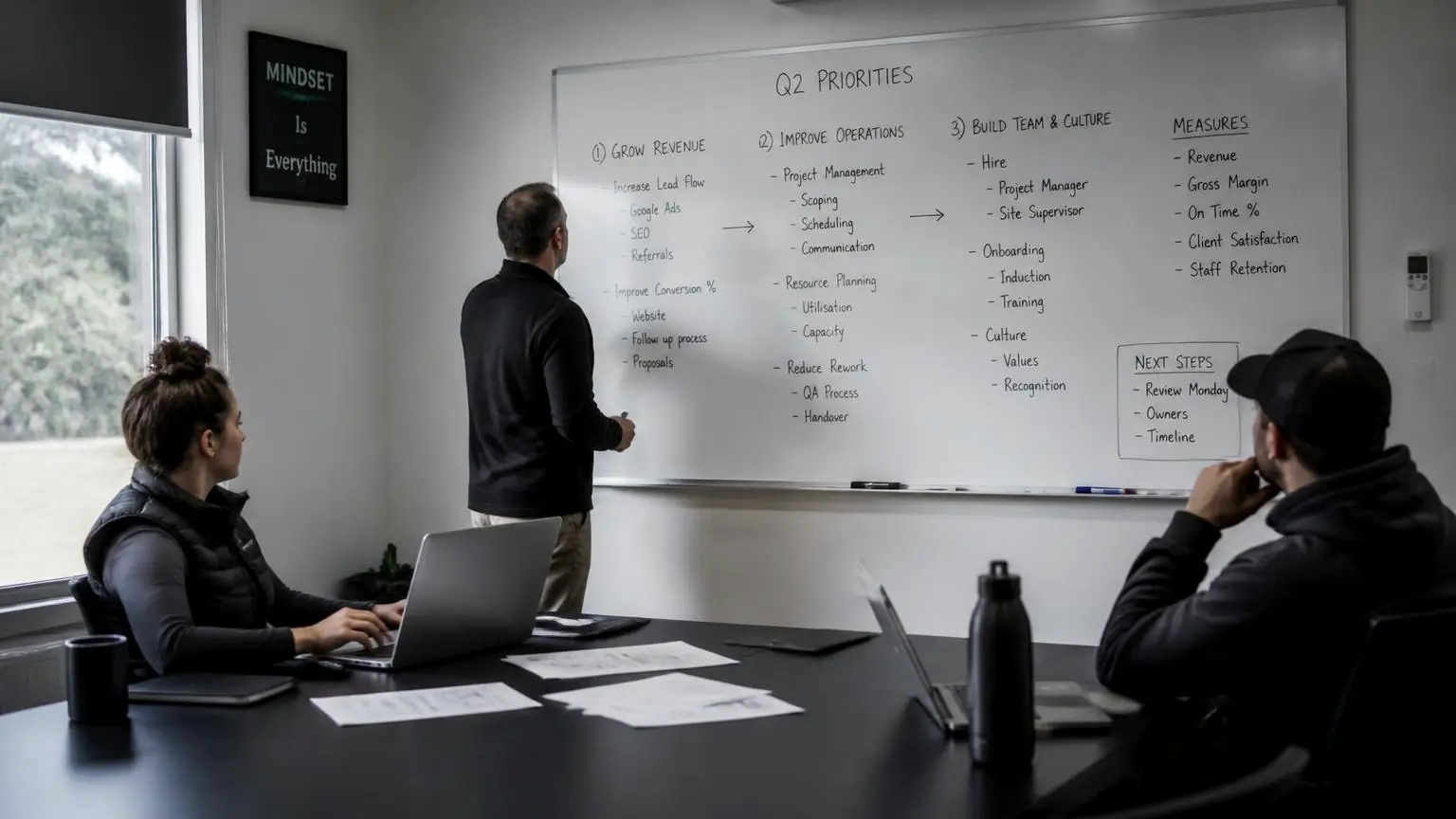
One question, answered properly
Should I hire a GM or COO, or promote from inside?
Should I change my pricing, and by how much?
Buy, build or replace the system?
Open the second site, wait, or partner?
Take the big contract or walk away?
Outsource the function or keep it?
Five steps, start to decision
- 1
Decision brief and kick-off
Define the decision, constraints, success criteria and deadline.
- 2
Evidence
The numbers you supply plus stakeholder conversations.
- 3
Options
Three to five viable paths, always including do nothing or defer, scored against weighted criteria.
- 4
Decision memo
The recommendation, the scorecard, the assumptions, what would change the answer, and the first 30, 60 and 90 days.
- 5
Facilitated decision session
You and the people who have to execute, in one room, leaving with the call made and owners named.
Scaled to the size of the decision
Rapid Decision Review
from $3,000 plus GST
3 business days
One bounded decision, documents supplied, up to two stakeholder conversations, no modelling.
- 60-minute framing call
- Two to four options scored
- Four to six page memo
- 60-minute decision meeting
Decision Sprint
from $6,300 plus GST
9 business days
One consequential decision, up to four stakeholder interviews, a financial and operational read.
- Three to five options scored
- Six to nine page memo
- 30, 60 and 90 day first steps
- 90-minute facilitated decision session
Deep Decision Case
from $9,000 plus GST
3 weeks
Material decisions: second site, restructure, core system, customer concentration.
- Six to eight interviews
- Scenarios and sensitivity
- Nine to twelve page memo
- Two-hour decision session
- 30-day launch plan
The Decision Sprint is priced on its own and does not credit into a later service.
A weighted matrix, agreed before the work starts
The weights are agreed with you at kick-off, the scores are shown with their assumptions, and the memo names the two or three scores most likely to change. Scoring makes assumptions visible; it does not make the decision for you.
The decision should plausibly move at least $90,000 of annual profit, revenue, capacity or avoidable risk. If it is smaller than that, the free Operating Scan and a call is the better first step.
The decision, and its consequences, remain yours. Ajility provides analysis and a recommendation, not a guarantee of outcome, and does not give advice on financial products, capital raising, tax or law; where a decision turns on those, we say so and refer you to the right adviser.
Ajility provides operational and management consulting only. We do not provide accounting, tax, legal, audit, valuation, financial product or lending advice, and nothing we provide should be treated as any of those. Where a matter falls outside our scope we will say so and refer you to a licensed adviser.
Common questions
How is this different from the Operating Diagnostic?
One decision versus the whole business. The Diagnostic tells you what to fix first. The Sprint tells you which way to jump on a question you already have.
What do you need from me?
The numbers you have, access to the people involved, and a deadline.
What if the answer is "do nothing"?
Then that is the recommendation, with the trigger that would reopen it.
Can it run remotely?
Yes for the Review and the Sprint. The Deep Decision Case usually includes a site visit.
What happens after?
The memo is yours. The Decision Sprint is priced on its own and does not credit into a later service.
Should I hire a COO or a general manager?
A general manager usually runs the business day to day with P&L ownership as the founder steps back; a COO runs operations beside a founder who stays as CEO. Decide which seats the founder keeps first. Ajility can define the role before you recruit.
Should I bring in a business partner or hire a COO?
A partner shares ownership and risk; a COO shares the operating load. If you need capital or a co-owner's commitment, look for a partner and take legal advice. If what you need is execution, a fractional COO provides it without changing ownership.
Should I hire a COO or promote someone internally?
Promote when an internal leader already has the team's respect and has shown the judgement the seat needs; hire when the gap is capability nobody has. Define the seat and its scorecard first either way. Ajility's Decision Sprint scores this exact question.
How do I write a business case for replacing our core system?
State the problem in operating terms, the options including doing nothing, total cost over the system's life, measurable benefits with owners, and the risks. Ajility's Decision Sprint is built for buy, build or replace questions like this one.
Should I open a second site or wait?
Test it as a decision, not a feeling: can the first site run without you, does the second site's case hold on conservative numbers, and is there cash for a slow start? Score opening, waiting and partnering against agreed criteria before committing.
Related expertise: Planning, budgeting and forecasting and Pricing and revenue management.
Related service lines
Have the decision made in weeks.
Bring the question. We will tell you on the call which of the three fits, and what it will take.